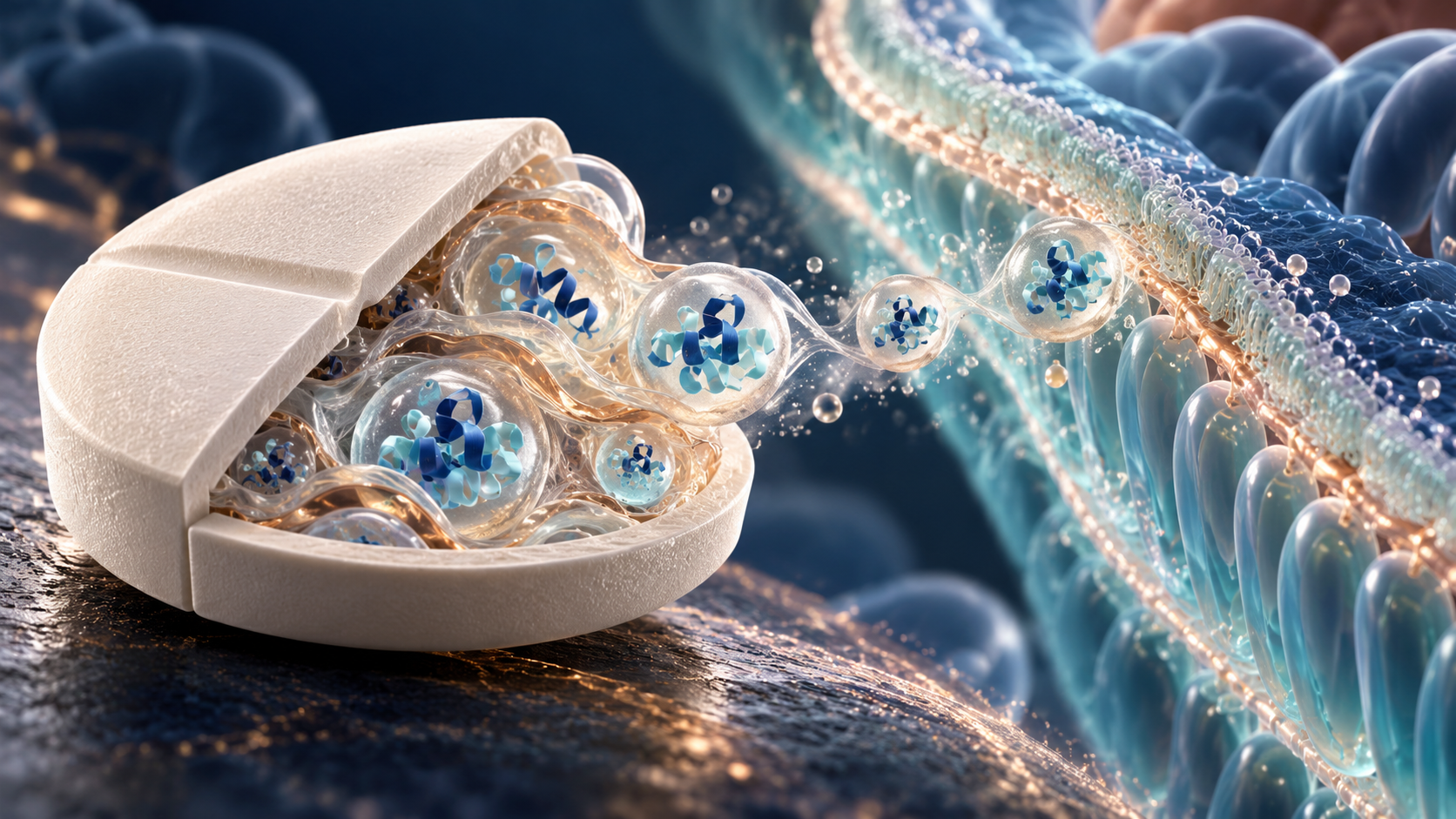
A tablet looks wonderfully ordinary. It can conceal an extraordinary delivery problem. For a peptide medicine, being swallowed is only the beginning: enough of the intended molecule must survive, cross a biological barrier and reach the circulation in a form and amount that can do useful work.
This is why the question “Can peptides be taken orally?” is too broad for a useful yes or no. Some oral peptide formulations have clinical evidence and regulatory approval. That achievement does not establish that any peptide placed in a capsule will behave similarly. The formulation is part of the intervention, rather than packaging around an otherwise complete idea.
Oral semaglutide makes a particularly revealing case study because researchers have investigated both the delivery mechanism and what happens in humans. It also shows why an explanation of absorption should remain connected to the exact product that was studied.
Getting across is a separate scientific problem
Digestion creates an obvious obstacle for molecules built from amino acids. Enzymatic breakdown and poor passage across gastrointestinal membranes can limit peptide delivery. Simply starting with more material does not establish that the right amount of intact drug will arrive where it is needed. It also does not answer questions about variability or safety.
In a 2018 primary study, researchers investigated semaglutide co-formulated with the absorption enhancer salcaprozate sodium, commonly called SNAC. Work in humans and dogs supported absorption in the stomach, near the tablet surface. The findings supported local pH buffering that helps protect semaglutide from degradation, together with enhanced transport through cells. The reported mechanism was specific to the semaglutide–SNAC combination; it was not evidence for generally opening gaps between intestinal cells. See Buckley and colleagues' original absorption study.
The local nature of that process is important. The image of a tablet uniformly protecting the entire digestive tract, or an enhancer making every nearby peptide absorb equally well, goes beyond what this study established. So does borrowing the name SNAC as if it were a universal stamp of successful delivery.
Notice the evidentiary steps embedded in the research. Observing where absorption occurs is one question. Investigating a mechanism is another. Measuring blood exposure in humans is another again. These findings can reinforce each other while retaining their separate limits. A useful explanation keeps the human and animal components visible rather than merging them into an unspecified “study.”
Exposure depends on the conditions
A subsequent pair of randomized studies in healthy volunteers examined how conditions around oral administration affected semaglutide exposure. Food and the tested administration conditions mattered. The studies involved 78 and 161 participants and measured pharmacokinetics, the behavior of drug concentrations over time. They were not trials demonstrating long-term disease outcomes. The original human pharmacokinetic research explains the distinction.
For an evidence reader, the practical implication is that administration instructions can be part of how a formulation achieves its studied exposure. They are not decorative details to strip out when summarizing the technology. Equally, an experimental comparison of conditions is not a menu for inventing a personal regimen. Product-specific instructions belong with the actual prescribed product.
This also helps explain why the number printed on one tablet cannot be treated as a universal conversion to another formulation. Current US prescribing information explicitly says that Rybelsus and Ozempic tablets are not substitutable milligram for milligram. The label identifies distinct formulations rather than granting permission to calculate an exchange from the ingredient name. See the current shared US tablet label.
By October 2026, Wegovy also has a US tablet formulation. Its existence broadens the approved oral semaglutide landscape; it does not erase the need to read the particular formulation's indications and instructions. The current Wegovy label separates the tablet and injection information.
Reaching blood is not the final endpoint
Demonstrating absorption is a substantial technical achievement. Demonstrating clinical benefit requires another kind of evidence. PIONEER 1, for example, randomized 703 adults with type 2 diabetes in a double-blind, placebo-controlled trial lasting 26 weeks. It evaluated oral semaglutide using clinical measures including glycated hemoglobin, or HbA1c, and body weight. Those patient data answer a different question from a laboratory explanation of gastric transport. See the PIONEER 1 publication.
The distinction protects both sides of the argument. An elegant mechanism deserves credit for explaining a delivery approach. A clinical result deserves credit within the population, formulation and outcomes actually studied. Neither becomes evidence for an unrelated oral peptide supplement just because all three products can be described with similar vocabulary.
When assessing an oral delivery claim, look for a chain of evidence that stays intact. Was the finished formulation studied, or only an ingredient? Was intact drug exposure measured in humans? How variable was it, and under what conditions? Did a suitable clinical study then evaluate outcomes in the intended population? Is the marketed claim about that same formulation and use?
A missing link does not prove that a new approach cannot work. It tells you what remains unestablished. That is a more useful conclusion than either assuming every swallowed peptide is destroyed or assuming an approved oral medicine validates the entire category. The ordinary-looking tablet is the endpoint of a very particular engineering and evidence problem.

A thought worth keeping?